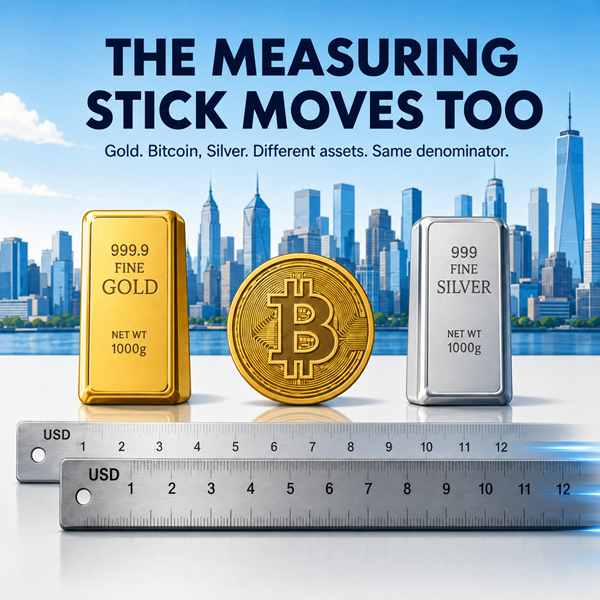
Gold and Bitcoin are rising together. Why?
By Jodi Stanton, CEO of Rush
For years, one of finance’s loudest arguments has been gold versus Bitcoin.
Peter Schiff became synonymous with the case for gold. Michael Saylor with the case for Bitcoin.
Physical scarcity versus digital scarcity. Thousands of years of monetary history versus a hard limit of 21 million.
Gold or Bitcoin.
I’ve never really seen it that way. I’ve always held them in different parts of my own portfolio, for different reasons.
Which makes the current market interesting.
Gold is rising again. Bitcoin is rising too. Silver has joined them.
So what, if anything, are they telling us?
Gold or Bitcoin? Maybe that was the wrong question.
Gold and Bitcoin haven’t suddenly become the same asset because their prices are moving in the same direction.
Their markets are very different.
Gold is physical, held by central banks as well as investors, with thousands of years of monetary history behind it.
Bitcoin is digital, far younger and considerably more volatile. Its market is changing too. ETFs have opened a major new route for institutional capital, while Bitcoin’s historic four-year cycle has plenty of investors asking whether its strongest phase has already passed — or whether the old cycle still works the way it used to.
Silver is different again, with a large part of its demand coming from industry.
Three assets. Three different stories.
Yet right now, all three are moving higher.
That makes the old question — gold or Bitcoin? — less interesting than another one.
What are they reacting to at the same time?
Same direction doesn’t mean the same destination.
This is where it pays not to read too much into price alone.
A rising price tells us buyers were prepared to pay more.
It doesn’t tell us why.
A Bitcoin buyer might believe another leg higher has begun. Or they might simply be covering a short.
A gold buyer might be responding to geopolitical risk, central-bank demand or portfolio positioning.
Silver has its own supply-and-demand dynamics.
So the recent moves don’t prove investors suddenly see gold, Bitcoin and silver as one big trade.
And they certainly don’t tell us where any of them go next.
But when assets with very different fundamentals start moving together, it is worth looking for the pressure point they share.
The measuring stick moves too.
We naturally focus on the asset.
Gold supply. Bitcoin cycles. Silver demand.
But an asset price is not absolute. It is a ratio.
There is the asset.
And there is what we use to price it.
For gold, Bitcoin and silver, that is usually the US dollar.
And right now, the dollar is worth watching.
The dollar has been trading near multi-month lows as markets focus again on US debt, long-term Treasury yields and the government’s growing financing challenge.
US federal debt has now passed $40 trillion.
Last week, after long-term yields climbed sharply, the US Treasury doubled the size of some buybacks of longer-dated bonds to support market liquidity.
Markets took notice. The dollar weakened, while gold and Bitcoin moved higher.
None of that means a weaker dollar automatically sends either asset higher.
Nor does it mean concerns about the dollar explain every move in gold or Bitcoin.
But it does help explain how two assets with very different investment cases can respond to the same underlying pressure.
Gold and Bitcoin don’t need the same thesis to share the same pressure point.
None of this settles the gold-versus-Bitcoin debate. Nor does it tell us where either asset goes next.
But it is a useful reminder of how prices work.
No asset price is absolute. It’s always a ratio.
When very different assets rise together, it may not be only the assets that are moving.
Sometimes the measuring stick is moving too.