Unlocking Australia’s $24 billion digital finance dividend: New DFCRC report outlines productivity gains and policy path to accelerate growth
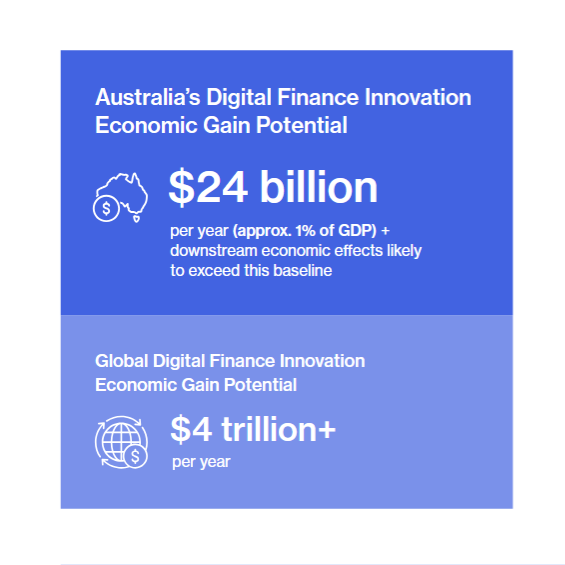
Australia could unlock a $24 billion annual economic opportunity from digital finance innovation, equivalent to around 1 per cent of GDP, but risks capturing only a fraction of these gains without targeted policy action, according to new research released by the Digital Finance Cooperative Research Centre (DFCRC).
The report, Unlocking Australia’s $24 billion Digital Finance Opportunity: The Economic Impact Potential of Digital Finance Innovation in Australia, is the culmination of year-long research in collaboration with the Digital Economy Council of Australia (DECA). It finds that modernising financial system infrastructure through technologies such as tokenisation and distributed ledgers could significantly improve the efficiency of markets, payments and financial assets.
The research identifies three core areas of economic gain: better markets ($10 billion annually), better payments ($8 billion annually) and better assets ($6 billion annually), with broader downstream economic benefits likely to be even higher.
DFCRC’s research shows the greatest efficiency gains from tokenisation are likely to come from improving the performance of high-turnover asset classes, with foreign exchange alone representing an estimated $7.2 billion annual opportunity, followed by investment funds ($2.2 billion), public debt ($1.3 billion) and public equities ($1 billion).
However, the data reveals a sobering ‘realisation gap’. On its current trajectory, Australia is set to capture only about $1 billion per year in digital finance economic gains by 2030, with regulatory uncertainty, coordination challenges and limited pathways from pilot projects to scaled deployment identified as key constraints.
Accelerating economic gains: 3 key policy priorities
To unlock the full economic potential, the report outlines three priority actions, based on Australian industry data and the highest-impact economic gain categories:
- Establish a Digital Financial Market Infrastructure (DFMI) sandbox to support transitions from pilot to production: A coordinated, multi-agency sandbox could support the evolution of licensing frameworks, provide a stage-gated path to production for tokenised financial market use cases, and build on Australia’s strengths and international best practice.
- Evolve the licensing framework for tokenised financial markets: This would complement existing progress on Australia’s modern digital finance regulatory architecture.
- Deploy foundational infrastructure, including tokenised Government bonds and wholesale Central Bank Digital Currency in the DFMI sandbox: The data suggests these foundational components would support the development of tokenised markets, collateralised lending, and related services.
DFCRC Co-CEO and Chief Scientist, Talis Putnins, said, “We are witnessing a once-in-a-generation transformation where Digital Finance is becoming a foundational layer of the global financial system and Australia has a significant opportunity to capitalise on this. We’ve quantified a significant $24-billion-a-year economic opportunity – equivalent to around 1% of GDP – but the window is narrowing to transform and strengthen our financial system and secure a competitive role in the rapidly evolving global digital finance ecosystem.
“We’ve proven the technology works. The challenge now is moving from pilots to real markets, with real capital, under fit-for-purpose regulatory frameworks. We need to act quickly via coordinated, innovation-enabling policy and regulatory clarity, combined with stronger collaboration across industry, regulators and government. By working together, and at pace, we can seize this opportunity for Australia.”
DECA CEO, Amy-Rose Goodey, said, “This is a pivotal moment for the sector – and for Australia – if it is to realise its opportunity in digital finance. This report provides the definitive evidence on the significant digital finance innovation opportunity in Australia that our industry and government have been asking for.”
DECA Chair and CEO of OKX (report supporter), Kate Cooper, said, “Digital finance represents a structural shift in how value moves through the economy. The large annual opportunity identified in this research reflects productivity gains from faster settlement, lower friction and modernised capital markets – not price cycles.
“Long-term economic benefits will only be realised through clear regulatory frameworks and infrastructure built to institutional standards. That is how Australia strengthens trust, attracts capital and secures its place in the next era of global finance.”